Cable Fault Location
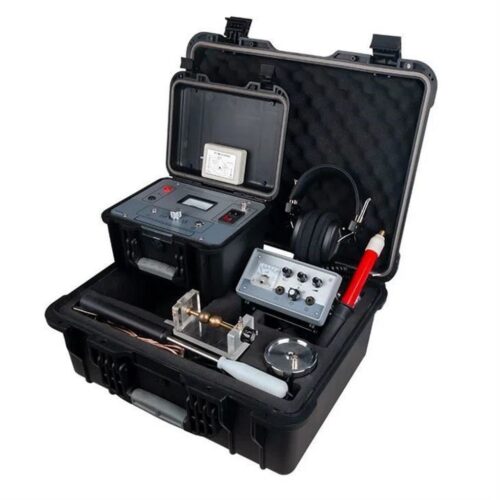
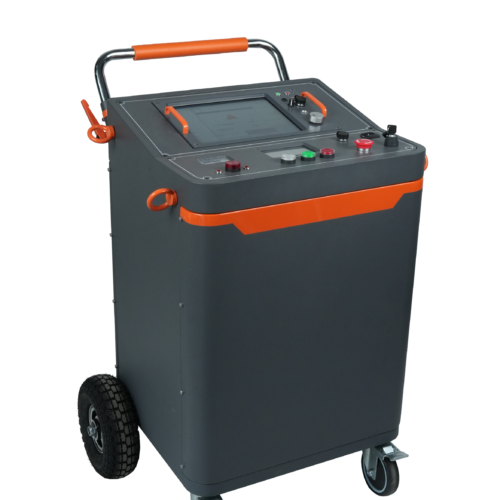
We offer a range of systems designed for fault location and cable tracing. They are designed to address the following tasks:
▪ High-voltage direct current insulation testing of power cables.
▪ Insulation breakdown on damaged cable sections using direct current.
▪ Accurate determination of cable fault locations using the acoustic method with an impulse generator and receiver.
▪ Preliminary localization of cable faults using reflectometry and low-voltage Time Domain Reflectometry (TDR) impulse methods, as well as high-voltage methods:
• ARC/ARC multi-shot (single/sequential pulse arc method) for high-resistance and intermittent faults, with minimal impact on the cable.
• ICE (Impulse Current Excitation) for high-resistance faults that do not convert to low-resistance faults through insulation breakdown.
• DECAY (Voltage-coupled decay method) for high-voltage breakdown faults
Our receivers can operate in both acoustic and induction modes. In acoustic mode, the receiver accurately identifies power cable fault locations using the acoustic method. In induction mode, the receiver is used for cable tracing, cable selection from a bundle, determining the depth of underground cable lines, and precise localization of power cable faults using the induction method.
During fault location, the reflectometer can be used independently to determine the distance to low-resistance cable faults. It can also be used in conjunction with the testing and burning module and impulse generator for preliminary localization of high-voltage fault sections.
In the KiloVolt products we offer, we emphasize:
▪ Mobility.
▪ Safety.
▪ Accuracy.
▪ Compactness and convenience.
▪ Versatility.
▪ Digital control.
▪ High power.
▪ Wide frequency selection.
▪ Automatic impedance matching.